 Stories in Structure
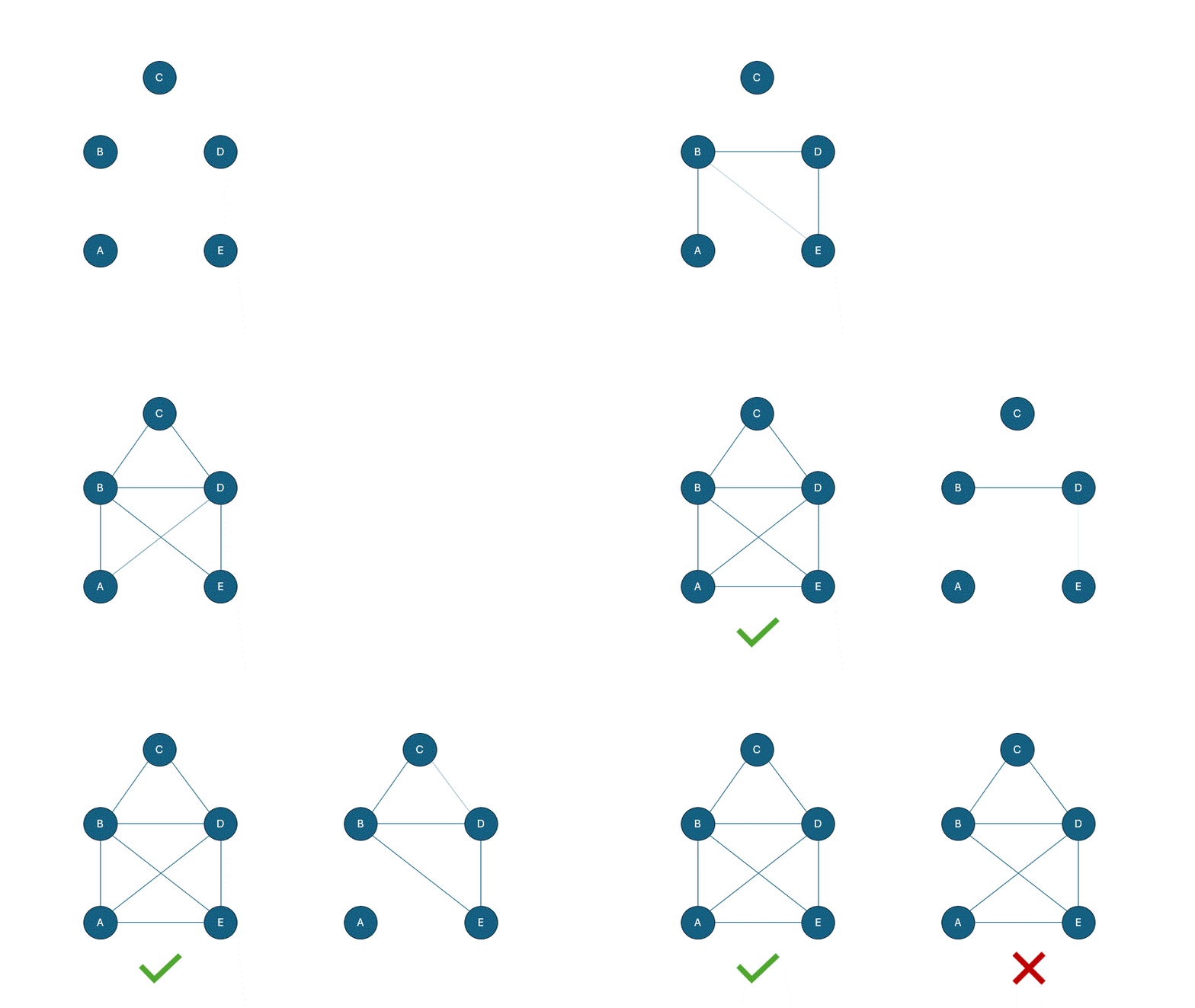
Let’s play a game. Your task is to draw a house by connecting the dots without lifting your pen (or pencil, or mouse). You can visit a dot multiple times, but you are allowed to draw an edge only once!
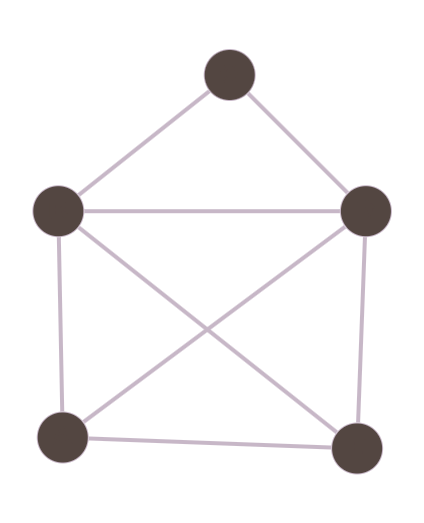
Depending on which dot you choose as your starting point — you’ll either succeed or fail. But why?
What we’re doing here is traversing a graph. This is our house graph:
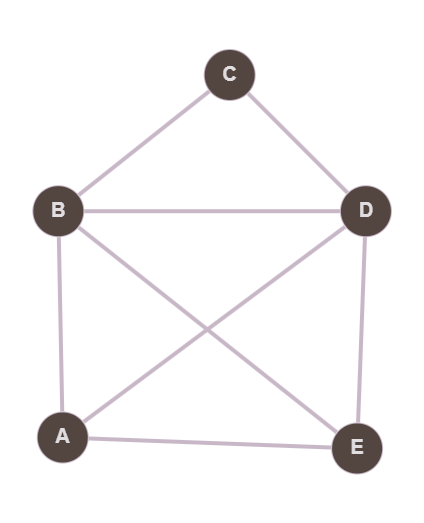
A graph is a structure made of nodes (also called vertices) and links (or edges), with each link connecting a pair of nodes. In this case, we have five nodes: A, B, C, D, and E, and 8 edges: A-B, A-D, A-E, B-C, B-D, B-E, C-D, D-E.
What’s more, the house graph is an undirected graph, meaning you can traverse each link in either direction — from A to B or B to A.
Now, back to the question: why does starting from node A let you draw the house in one go, but starting from B doesn’t?
To answer this, we need to look at something called node degree — the number of links connected to each node in an undirected graph.
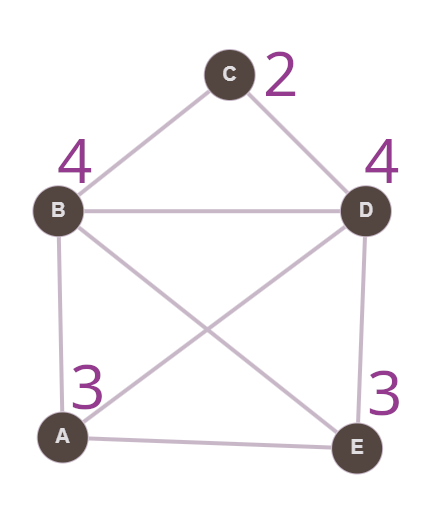
Back in 1735, Leonhard Euler showed that in order to traverse such a graph in a single go — without retracing steps — you must start at a node with an odd degree and end at another node with an odd degree. All other nodes must have an even degree. He actually proved it here.
Since there are exactly two nodes with an odd degree (A and E) and all other nodes (B, C, and D) have even degrees:
- There is an Eulerian path in the house graph, meaning it is possible to draw all edges in one go.
- You must either start drawing from A and end at E, or start at E and end at A.
Check your knowledge: Bridges of Königsberg
To test your understanding, try this rule on the famous Bridges of Königsberg. This is the problem that led Euler to formulate the rule in the first place. His question:
> Can you walk through the city, crossing each bridge exactly once?
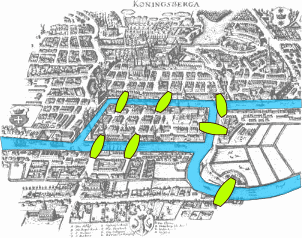
When we translate the city into a graph, pieces of land become nodes and bridges become edges, like so:
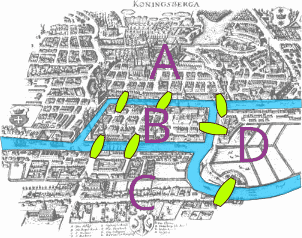
Let me know in the comments what the node degrees are, and whether you found the solution to Euler’s question!
Summary
That was the shortest intro to graphs I could come up with :)
We’ve touched on:
- Nodes (vertices)
- Edges (links)
- Undirected graphs, where movement is allowed in both directions
- Node degree, and how it affects traversal
- Euler’s recipe for drawing a graph in a single stroke — the Eulerian path.